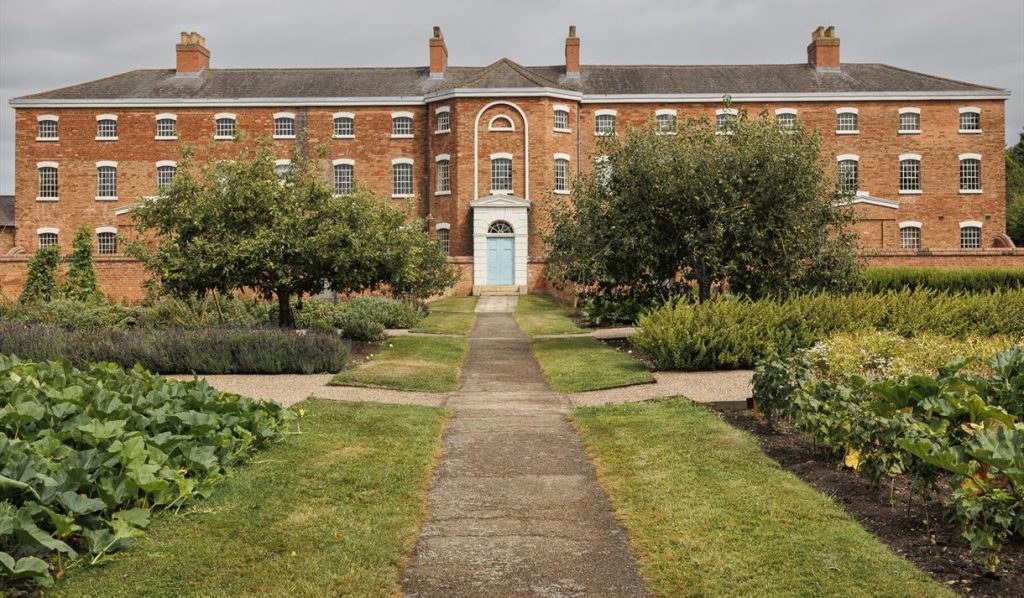
In February Colin Deeley gave us a very interesting and detailed ‘history of Southwell Workhouse and the Infirmary.’ Every workhouse had a designated area for use as an infirmary. Elizabeth 1st introduced the Old Poor Law which forced parishes to provide for their destitute parishioners, by providing coal, food and clothing paid for by parish ratepayers. However, in 1775, a loaf of bread cost 1 shilling (or £4 in today’s money) due to 3 years of bad harvests, resulting in many more paupers needing weekly handouts, and the Rev John Thomas Becher of Southwell suggested his local parishes combined their funds and built a workhouse to house, feed and clothe the destitute in exchange for their labour. The building, which was partly designed by Becher himself, was completed in 1808 to house over 84 people, but then extended in 1824. Although originally called the Thurgarton Hundred Incorporated Workhouse, but it later became known as the Southwell Union Workhouse.
In 1828 Becher wrote a paper entitled ‘The Antipauper System’, which resulted in the Government bringing in the Poor Law Amendment Act in 1834 and building workhouses around the country.
The workhouse took in men, women and children, who were looked after by the Master and Matron, assisted by a clerk, chaplain, medical officer and school teacher, all employed by a board of 62 guardians who also made the rules. Bad behaviour did not happen very often, but when it did, the inmates were sent to the refractory, which also happened to house any dead inmates who were awaiting removal by their home parish which was responsible for their burial.
The young and infirm were looked after very well, as they received free health care and education. However, life for the able-bodied adults was purposely hard in order to encourage them to leave and get a job.
Able-bodied men had to crush stones for road building and pick oakum, which was teasing apart of the fibres of old ship rigging, which was very hard as it was covered in tar. When clean, the fibre was sold back to the ship yards and used as wadding or caulking between the wooden planks on a ship. Men also worked every day in the 6-acre gardens, growing fruit and vegetables to supply to the kitchen. Any excess was sold to the public (as it is today).
Women did all the cooking, cleaning and sewing, or worked in the laundry where they earned money by doing washing for outsiders. Any money earned was used by the Master to provide additional perks for them, usually in the way of food.
Men, women and children were segregated, and lived and worked in separate parts of the building, sleeping in dormitories on the second floor of each wing, and often sleeping several to a bed. The staff were provided with their own private self-contained accommodation on the top floor of the main building. There was a school room for the children, and youngsters were taught to read, write and do arithmetic, and were able to get jobs when they left. Families often only met up once a week.
In 1929 the New Poor Law system was disbanded, and workhouses were handed over to local authorities, as institutions for the poor, homeless and elderly. However, when the modern welfare system started in 1948, the building’s use changed, providing temporary homeless accommodation until 1976.
2nd April 2025 – Dorothy Gaughan – Food Bank – How it works, at 7.30 for a 7.45 pm start, at Allington Village Hall. Visitors are most welcome to attend, at a visitor’s fee of £5.00.
Stamps and used printer cartridges
Used postage stamps are collected for the Royal National Institute for the Blind (RNIB).
Used printer cartridges, of all types, are recycled to raise money for the David School in Sierra Leone, with the motto ‘Education Changes Lives’, which was founded over 15 years ago, to provide education for children where there was no school.
Further information contact – allingtonwi@gmail.com